What Is Google AI Mode?
Imagine a search that feels like a conversation with your own assistant. With Google AI Mode, you can ask long questions, upload pictures, and even get personalized suggestions. This google ai mode tool uses a gemini 2.5 model to break your query into multiple parts using a query fan‑out technique, then merges the results into one answer. This ai‑powered google search helps you book tickets, compare products, or plan trips. It knows your context, so it offers an ai mode personalized search that feels tailored just for you. Discover how this new search experience works and why it’s trending. Get ready to explore the future of search today.
World appetite for innovation is huge, so when google ai mode launched, early adopters dove in. This ai‑powered google search feature is more than a new tab. Unlike classic blue links, google ai search mode uses a gemini 2.5 model to return conversational answers. People tap the google ai search engine to ask long, complex questions. The system uses the query fan‑out technique to break a query into sub‑searches and synthesize results. The outcome is a rich, personalized response rather than a simple list of links.
Users care about availability. The google ai mode us release began as a Search Labs experiment in March 2025 and rolled out publicly in May 2025. Since then the experience has expanded to other countries, but adoption in the States remains strong. The sge ai mode (Search Generative Experience) label underscores that this is part of Google’s broader generative AI push. Early usage numbers suggest high interest and that the ai mode search volume is growing.
How Does Google AI Mode Work?
At its core, the mode functions like an assistant. When you enter a question or upload a photo, the google ai deep search engine first recognizes the input across text, images and voice. It records context from your device, location and past activity. This understanding helps the ai mode personalized search craft a relevant response. The engine then runs the google ai mode step‑by‑step process known as query fan‑out technique. It fires off many smaller searches across the web, Google’s Knowledge Graph and shopping data to gather information.
After retrieving hundreds of documents, the gemini 2.5 pro model classifies your intent—whether you want to buy, compare or learn. Specialized sub-models compile a unified answer. The result appears on a dedicated tab; you can see text, images and tables with links. If the system lacks confidence, it will revert to standard results. This seamless flow explains how google ai mode deep search explained features work. You can refine the conversation by asking follow‑up questions. That interactivity makes the experience distinct from traditional search.
Query Input (Multimodal)
With AI Mode you can submit queries via text, voice or images. A traveler might snap a picture of a recipe and ask for nutrition facts, while a student speaks a question about climate science. This ai mode multimodal (voice, text, image) search makes the tool more accessible and encourages natural language.
Context & Interpretation
The system absorbs context like your location, device, browsing history and even Gmail messages. If you search for “best pizza nearby,” it knows to look at local pizzerias. This ai mode personalized search tailors results and ensures the answer fits your situation.
Parallel Queries & Document Retrieval
During deep search, the engine splits your question into multiple sub‑queries, then collects documents from the index. It pulls data from sources such as News, Shopping, Maps and the web. That’s how it gathers enough information to craft a comprehensive reply.
Classification & Answer Generation
Once the documents are assembled, the system classifies the query as informational, transactional or comparative. A specialized language model then generates a final answer. It highlights key facts and includes citations to credible sites.
Display & User Interface
The answer appears in a full‑screen window with citations and follow‑up prompts. You can click sources, ask more questions or switch back to classic search. The design feels like an evolving conversation rather than a list of results.
Google AI Mode vs AI Overviews: Key Differences
AI Overviews are brief summaries that appear above standard results. They provide a quick snapshot, but ai mode vs ai overviews reveals major contrasts. The overview uses the same underlying technology but lacks the depth and interactivity of AI Mode. Overviews run on a simplified gemini 2.0 model, while AI Mode uses the upgraded gemini 2.5 model. That upgrade improves reasoning and lets the system handle larger search fan‑outs.
In AI Mode, you control when to switch. It places results in a separate tab so you can navigate back to the web easily. AI Overviews appear automatically and may contain limited follow‑ups. Many people compare ai mode vs traditional search; the difference is stark: AI Mode aims to answer your question fully, whereas classic search provides options to explore on your own. This divergence shapes user expectations and will likely reshape SEO strategies.
Google AI Mode vs ChatGPT: Orientation & Comparison
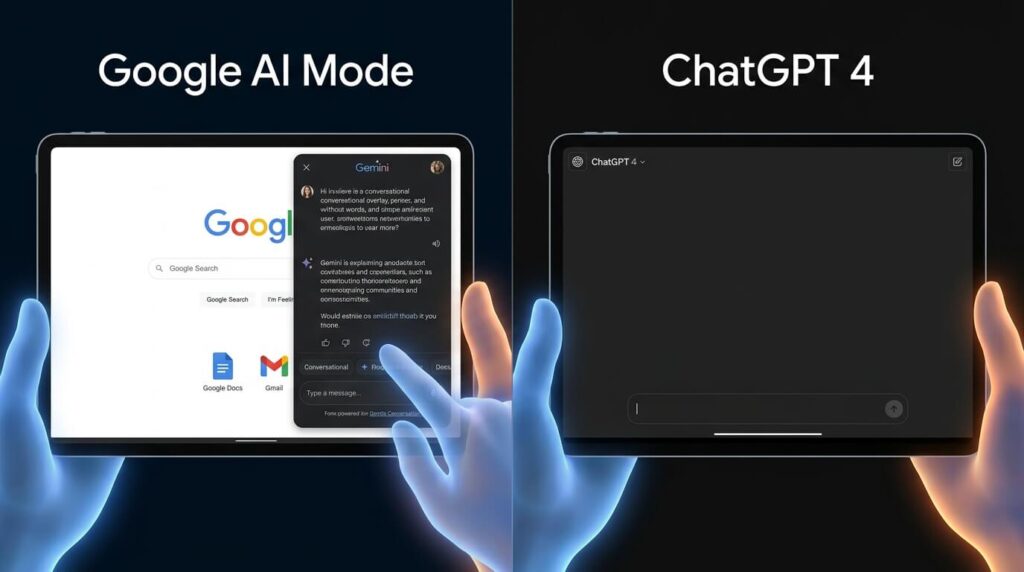
ChatGPT is a powerful conversational agent, but ai mode vs chatgpt shows distinct purposes. ChatGPT relies on training data with no live web access, so it cannot provide current events or personalized recommendations. Conversely, ai mode google connects to the internet. It accesses your Google services like Gmail and Maps for personalization. That means when you plan a trip, the system can check your travel confirmations and suggest activities.
Another difference lies in multimodality. ChatGPT mostly processes text, while ai mode multimodal (voice, text, image) search allows you to submit pictures and audio. Developers often compare ai mode vs openai / perplexity / chat-based search to illustrate this. AI Mode uses deep search vs ai mode to combine research and conversation, merging search results with chat. The result is a hybrid experience that draws from the strengths of both search and AI.
Orientation & Integration
AI Mode lives inside Google Search. You access it by clicking a tab or enabling the experiment. ChatGPT exists as an external site or API. Because of this integration, you can jump between search results and AI conversation seamlessly.
Data Access & Personalization
Google can pull from your messages, calendar and location. ChatGPT cannot. That data gives AI Mode an edge in tailoring answers, whether booking a dinner reservation or suggesting movies.
Functionality & Multimodality
ChatGPT excels at creative tasks like composing poetry. AI mode google excels at research and planning. It also accepts pictures and voice queries, making the experience more accessible and dynamic.
Core Features of Google AI Mode
The heart of AI Mode lies in its features. The google ai deep search function runs hundreds of queries in the background to provide deeper answers. For example, if you ask, “How does the Fed’s interest rate affect mortgage rates?”, the system will collect articles, graphs and economic models and then summarize them. This function makes the tool ideal for research and decision‑making.
Another standout is agentic tasks google ai mode (ticket booking, reservations). By connecting to partners like Ticketmaster, StubHub and Resy, AI Mode can book tickets or reservations. It doesn’t just recommend; it helps you act. Personalized recommendations combine your email confirmations and calendar events to anticipate your needs. Visual data features, including project astra google (visual & live data integration), let you point your phone at objects and get real‑time information. These elements convert search into a personal assistant.
Deep Search
Deep Search performs hundreds of sub‑queries, merging them into a unified answer. It is ideal for complex research topics. Its scope covers news, academic papers and shopping comparisons, making it a core feature of the platform.
Agentic Tasks
This capability allows you to book tickets, make reservations or purchase items within the interface. It saves time and reduces friction. Instead of switching to another website, everything happens in one place.
Personalized Recommendations
AI Mode reads your emails and calendar to deliver tailored suggestions. For instance, if you booked a flight to New York, it might recommend restaurants near your hotel. The system learns your preferences and improves over time.
Visual Data & Live Functions
The project astra google (visual & live data integration) feature recognizes objects through your camera. It also supports virtual try‑ons for clothes or make‑up. This multimodal approach enriches the search experience.
This article explains how AI‑powered wireframing and text‑to‑UI engines are reshaping design and speeding up workflows.
Use Cases for Businesses and Users
AI Mode is not just a novelty. It has practical use cases. Shoppers can use google ai mode for shopping to compare products, check reviews and see prices at a glance. For example, searching for “best laptops under $800” returns a comparison table with specs and prices. The ai mode product comparisons are detailed and easy to read. You can also access ai mode event ticket booking through partners like Ticketmaster, making it easy to book concerts or sports tickets.
Researchers benefit as well. The ai mode for research feature compiles information from academic journals, news articles and blogs. A graduate student might ask about climate change policy and receive a synthesized report. Travelers can use ai mode travel planning to get itinerary ideas and bookings. Online retailers benefit from ai mode for ecommerce because the system surfaces products based on personal preferences. The tool also works as google ai mode research tools; marketing teams can quickly gather industry statistics.
Shopping & Product Search
AI Mode excels at shopping queries. It combines product details, reviews and price comparisons in one place. This integration saves time and makes purchasing decisions easier.
Event Tickets & Bookings
You can ask AI Mode to book tickets to concerts or reserve dinner tables. The system integrates with StubHub, Ticketmaster and Resy. It handles the transaction within the search interface.
Research & Complex Topics
Deep Search helps users gather information for essays or business decisions. It provides summarized reports with citations. This feature is useful for students, analysts and professionals.
SEO & Marketing Implications for Google AI Mode

Search Engine Optimization is evolving. The shift to AI‑generated answers means we must consider ai mode seo. Traditional ranking is less important when a system pulls information to build a single answer. Businesses must optimize for citations. Incorporate structured data, answer key questions in the first 200 words and provide verifiable facts. These steps improve your chance of appearing in the AI answer.
That guide explains why SEO keywords are the exact phrases people type into Google and how smart keyword research aligns content with real demand
We also need to consider ai mode ranking factors, such as relevance, topical authority and speed. Pages with Schema markup (FAQ, HowTo) perform better in citations. Because AI Mode reduces clicks, zero‑click searches are the norm. That’s where zero‑click search statistics come in. Brands can still get exposure through citations. Marketers should embrace answer engine optimization (AEO). Create content clusters to increase topical authority, add structured data to mark up answers and ensure good core web vitals & ai mode performance. In other words, tailor your google ai mode content strategy to make your content easy for AI to parse. This approach helps build ai mode citations / citation share and enhances ai mode content optimization.
Future Outlook and Expansion of Google AI Mode
The future looks bright. Adoption statistics show that millions use AI Mode daily, and the number is growing. In 2026, AI search is becoming mainstream. Google plans to expand to more languages and countries. Observers track ai mode trending 2026 and note that the platform may soon include even more interactive features. The ai mode adoption statistics suggest there is momentum to integrate AI into every search experience. Comparisons like google ai mode india vs usa highlight differences in adoption rates.
New features are coming. Google has teased more advanced projects like Project Astra for real‑time information and better personalization. They may incorporate more commerce options, deeper shopping integrations and improved support for event ticketing. As the technology matures, ai mode vs traditional search will become a less useful comparison; search and chat will converge. Staying informed about release schedules and improvements will help businesses stay ahead.
Interested in exploring more AI innovations? Visit our AI tools category to see how AI design tools can accelerate your creative workflow with smart automation, AI color palette generation, and intelligent design assistance. You’ll discover practical features like our AI palette generator and other tools that help modern UI/UX teams work faster and smarter.
Key Takeaways & Conclusion
AI Mode is transforming search. It’s no longer just a list of links; it’s a conversation with the web. By using the google ai mode, you get richer, more tailored answers. The tool uses the gemini 2.5 model and query fan‑out technique to deliver deep, well-sourced responses. It integrates images, voice and personal data to make search feel like a personal assistant.
For businesses, embracing ai mode seo and optimizing for citations will be vital. Use structured data and answer user questions quickly. Even without clicks, exposure in AI Mode builds trust and authority. For users, the future holds even more interactive and personalized features. The ai mode google experience stands at the frontier of search, changing how we learn, shop and plan every day.
AI Mode vs AI Overviews: Feature Comparison Table
| Feature | AI Mode | AI Overviews | Classic Search |
|---|---|---|---|
| Engine | gemini 2.5 model / gemini 2.5 pro | gemini 2.0 | Core ranking system |
| Interaction | Conversational; allows follow‑up questions | Limited; summary only | One‑off queries |
| Output | Full answer with citations, images and tables | Short paragraph with links | Links and snippets |
| Trigger | User selects AI Mode | Automatically triggered for select queries | All queries |
| Best use | Complex research, comparisons, decisions | Quick overview of a topic | General search |
Frequently Asked Questions
Exploring google ai mode, questions often arise about the rollout and usage. Our answers aim to clarify the most common doubts in plain language. You will learn when ai mode google launched, how to switch it on and why it differs from other search experiences.
These frequently asked questions also touch on ai mode adoption statistics, ai mode trending 2026 and what makes the feature unique for users. By the end, you will understand the differences between ai mode vs ai overviews, and feel confident enabling this new search tool.
When was the ai mode release date / ai mode rollout schedule?
Google introduced ai mode release date / ai mode rollout schedule as part of Search Labs in March 2025 and launched the public version on May 20 2025. A month later, it arrived in India and continues to expand globally, with adoption increasing across World.
| Date | Region |
|---|---|
| March 5 2025 | US – Search Labs experiment |
| May 20 2025 | US – Public rollout |
| July 8 2025 | India – Launch |
How to enable ai mode in google?
If you live in the United States or India, ai mode availability in us is automatically enabled when you are logged into a Google account. Users elsewhere can opt into Search Labs. Workplace and school accounts may require admin approval before enabling the feature.
What’s the difference between ai mode and ai overviews?
Though both rely on Gemini models, ai mode vs ai overviews shows stark differences. AI Mode appears on a separate tab and offers deep, personalized answers, whereas AI Overviews provide short summaries in standard search results. This distinction helps users choose the right tool.
Conclusion
Google’s google ai mode is reshaping how Americans find information. Powered by the gemini 2.5 model and query fan‑out technique, it turns complex searches into helpful conversations. Adoption continues to grow across, and people appreciate the blend of research, planning and personalization.
For marketers and creators, focusing on ai mode seo, structured data and answer optimization is key to securing ai mode citations / citation share. As we look toward ai mode trending 2026, staying agile and embracing this technology will help maintain visibility and authority in a rapidly evolving landscape.
Want to go deeper? Read Google’s official post, “Expanding AI Overviews and introducing AI Mode,” to see how Gemini 2.0 powers AI Mode, enables multi‑part questions, and retrieves real‑time data using the query fan‑out technique. This article explains how AI Mode lets you explore nuanced queries and follow up for richer answers. Read the full announcement for more insights and future updates.

I’ve spent over 8 years working across SEO, WordPress development, Laravel, and UI/UX design, helping businesses improve their websites, search visibility, and overall digital presence. My experience includes on-page and off-page SEO, technical optimization, content strategy, WordPress development, and user-focused design for a range of clients and businesses.
Over the years, I’ve worked with teams including Skyray Ventures, Dotrefl, and ESPA Builders, combining technical development with digital marketing to deliver practical, measurable results.
I’m currently developing Laravel-based web applications at Princess Tourism while also growing LayersPilot, a digital services platform focused on SEO, web design and development, and website customer care.
One project I’m particularly proud of is Catch Head, an AI-powered lead generation platform developed by my team and presented at the Microsoft Imagine Cup at the national level.
I’m especially interested in SEO, Generative AI, prompt engineering, and AI-driven content strategy, and I enjoy connecting with businesses and professionals looking to strengthen their online presence through technology and search.